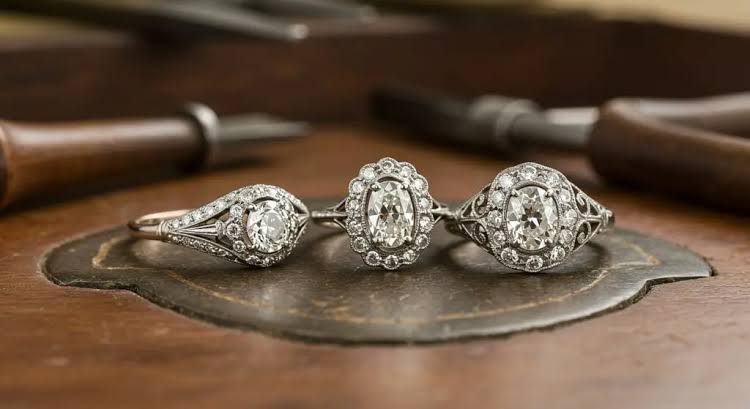
The appeal of antique engagement rings often starts with a detail: a shaped shoulder, a patterned border, or a setting unlike the ones in a modern display. That detail can inspire a question about the ring’s past, but it cannot answer every question by itself. Before choosing a ring for its history, find out which parts of that history the seller can explain.
This does not require becoming a jewelry historian. It requires separating what is visible, what has been assessed, and what remains unknown. A thoughtful purchase can include uncertainty, provided you understand it before making your decision.
Separate a period description from a date
Antique generally describes jewelry more than 100 years old. A period name provides a different sort of information, connecting the piece with a particular time or design tradition. Ask for the estimated date of manufacture instead of relying only on the heading of a collection.
Read for distinctions such as “style,” “inspired,” and “circa.” If the language is unclear, ask whether the seller means an original period piece or a later interpretation. Request an explanation in ordinary language, especially if historical age is a major reason for your interest.
It also helps to separate visual preference from a collecting goal. You may love a geometric arrangement without needing a ring from a particular decade. Alternatively, a documented period attribution may matter more to you than finding the largest center stone within your budget.
Write that priority down before comparing listings. Otherwise, it is easy to spend time evaluating details that will not determine your choice. The point is to understand your own reason for buying before asking a seller to help fulfill it.
Let design lead to better questions
Instead of memorizing a list of period features, describe what attracts your eye. Is it the outline, the spaces within the metalwork, the arrangement of smaller stones, or the contrast between colors? Specific observations give the seller something concrete to address.
Ask for photographs that show those features from more than one angle. A face-on image may communicate the pattern beautifully while revealing little about how the ring is built. A side view can make the same design feel quite different.
Keep notes as you compare antique engagement rings. Record the details you enjoy and the questions each piece raises, rather than relying on a growing folder of screenshots. A short comparison becomes especially useful when two rings share a similar first impression.
Consider your response to the whole ring as well. A favorite detail may occupy only a small part of the design, while the overall proportions feel wrong for your hand. Give yourself permission to admire a piece without making it your engagement ring.
Discuss alterations without assuming the answer
Ask what is known about previous repairs, replaced components, or changes to the setting. The useful question is what work occurred and how it affects the ring being offered now. Neither an unexplained repair nor a vague assurance gives you much to evaluate.
Keep your questions grouped so the conversation stays clear:
- What supports the estimated age of the ring?
- Which components are believed to be original, and which are known replacements?
- Are there photographs or written notes showing previous work?
- What is known about the stones, beyond their appearance?
- Which details remain uncertain?
Avoid asking the seller to invent a complete life story. Many ordinary objects reach the resale market without a continuous record of ownership. An honest limit to the available information is more useful than a confident account with no supporting material.
If originality matters strongly to you, say so at the start. Another buyer might care mainly about the present design and condition. There is no need to borrow a collector’s priorities if they do not reflect what you want to wear.
Read the paperwork against the actual ring
Ask the seller to identify what each available document addresses. Do not assume that a document concerning a stone answers every question about the surrounding ring. When its wording is unfamiliar, request an explanation of the relevant details.
Compare the written description with the photographs and the seller’s answers. Check that the materials, measurements, and stated condition are consistent across them. Resolve discrepancies while the purchase is still a decision, rather than after it has become a delivery.
Save the listing and correspondence together so you can find them later. This is especially helpful when your questions were answered across several messages. A short summary in one place prevents an important qualification from getting lost.
Before any alteration, ask what the proposed work would change and obtain a written estimate. Confirm the order of purchase, inspection, and alteration with the seller. Clear sequencing gives everyone the same understanding of what you have agreed to.
Choose a history you can understand
At the end of the search, revisit the reasons the ring first appealed to you. Are those qualities still present after the practical questions have been answered? A compelling description should support your interest in the object, not replace it.
Build a final shortlist that reflects both your preferences and the information available. Leave out any ring whose central selling point remains too uncertain for your comfort. The right amount of documentation is partly a matter of what you need to feel comfortable with the decision.
As you review the period styles represented by Gesner Estate Jewelry, ask about the individual ring rather than drawing conclusions from its collection label. Confirm the description, discuss any planned work, and keep the answers with your purchase records. That gives the next chapter of the ring’s history a clear beginning.